In a world defined by disruption and complexity, the biggest leadership challenge isn’t about a lack of skills. It’s about how the brain responds to uncertainty—and how we can train it differently.
Today, We Experienced Cognitive Load: the Complexity that Occupied our Brain
Leaders today operate in volatile, ambiguous environments. Rapid decisions, constant context switching, emotional labor, and overwhelming information flows create a state of chronic cognitive overload. Yet, most leadership programs focus on competencies, ignoring the brain that govern how we process and respond to such complexity.
The reality is; The brain is the true performance engine, and it’s time for leadership development caught up.
Know These Three Core Brain Networks That Shape Leadership
Modern neuroscience shows that your potential doesn’t reside in just one part of the brain—it emerges from how three core neural networks interact in real time. Together, they form the foundation for how we lead, adapt, and make decisions under pressure:
- Default Mode Network (DMN): This network activates during self-reflection, mental time travel, and envisioning the future. It’s essential for strategic thinking, self-awareness, and purpose-driven leadership. Overactivation, however, can lead to overthinking or rumination.
- Central Executive Network (CEN): This system drives goal directed task, problem-solving, and high-stakes decision-making. Leaders rely on it when solving complex problems, prioritizing tasks, or staying mentally agile. A well-regulated CEN supports clarity and sustained performance under pressure.
- Salience Network (SN): The brain’s internal “switchboard,” the SN constantly monitors your environment and determines what’s most important—whether it’s a threat, an opportunity, or a shift in context. It also helps regulate emotions and transitions between the DMN and CEN. This is crucial for emotional intelligence and adaptive leadership.
These networks constantly shift and balance in real time, shaping a leader’s adaptability, resilience, and insight (Menon, 2011; Seeley et al., 2007; Raichle, 2015).
When these networks are coherent and flexible, leaders operate with clarity and agility. When disrupted, they become reactive, impulsive, or disengaged—even if their “skills” remain intact.
Vibrant Brain Systems™: A New Framework for Leadership Agility
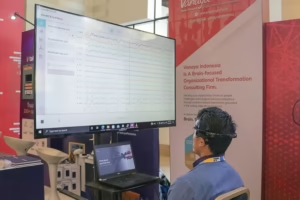
At Vanaya NeuroLab, we use neurotechnology tools and neurocognitive profiling to map how these networks behave in the face of challenge. This has led to the creation of the Vibrant Brain Systems™ framework, a neuroscience-based model that explains:
- How leaders process ambiguity and overload
- Which neural patterns support emotional intelligence and executive function
- What brain states correlate with change agility, resilience, and foresight
In essence, the Vibrant Brain Systems model reveals how the inner architecture of the brain drives outer leadership behavior.
By identifying these patterns, we can shift the conversation from “what leaders do” to how their brain enables—or constrains—them from doing it.
Coaching as a Neural Performance Strategy
This leads to a radical reframe:
Coaching is not just support—it’s a strategic intervention for developing brain capacity.
Well-structured coaching conversations can modulate brainwave patterns, strengthen prefrontal activation, and facilitate neuroplasticity. For example, EEG studies show:
- Increased Alpha activity during self-regulation and ideation phases
- Decreased Beta reactivity after reframing stress responses
- Stronger Frontal Midline Theta in moments of insight and focused control (Klimesch, 2012; Cavanagh & Frank, 2014; Tang et al., 2015)
This moves coaching beyond psychology—it becomes a tool for real-time brain rewiring, enabling more strategic, composed, and adaptive leadership behaviors.
The Brain Gap: A Leadership Blind Spot
Despite this growing evidence, most leaders remain unaware of the neurobiological basis of their performance. The result?
- They attend skills-based workshops but return to reactive habits.
- They set intentions but struggle to sustain attention.
- They value emotional intelligence but don’t understand what regulates it.
Until we close the brain gap, potential will remain untapped—not because leaders aren’t trying hard enough, but because they’re not training the system that drives behavior.
📚 Key Scientific References
- Cavanagh, J. F., & Frank, M. J. (2014). Frontal theta as a mechanism for cognitive control. Trends in Cognitive Sciences, 18(8), 414–421.
- Klimesch, W. (2012). Alpha-band oscillations, attention, and controlled access to stored information. Trends in Cognitive Sciences, 16(12), 606–617.